
How to Actually Calculate Your Stress Levels (and Stop Lying to Yourself About It)
Burnout is a term that gets thrown around a lot these days. In fact it’s on its way down the bell curve from its peak as a contribution to the millennial worker bee awakening against the oppressive corporate machine, to a term you can now find in the title of your annual mandated HR training module. But burnout is a very real thing that society is starting to pay attention to.
What is it? Burnout is a state of chronic physical and emotional exhaustion, often resulting from prolonged stress, overwork, or unrelenting demands in both personal and professional environments. It can occur in various contexts—workplace, caregiving situations, or academic pressures. And this is how we typically think about burnout: in a vacuum, related to a particular environment or situation.
“I’m burned out at work.”
“Parenting is burning me out.”
“I’m burned out from taking care of my aging parents.”
Sure, all of that is true. But here’s what nobody tells you: burnout isn’t just about one thing. It’s about everything, all at once, compounding like interest on your student loans.
The Most Common Modern Day Examples of Burnout: An entitled American middle class sob story
The most common example in my network of overworked and entitled middle-aged Americans is being burned out from parenting. Our middle class boomer parents worked hard to shield us from the horrors of being new parents, and as much as I like to claim our brave admission of how brutally difficult it is to be a parent (yes sharing an instagram meme is courageous) as societal progress, they had things like single income households (i.e. stay-at-home parents) and church communities to help shoulder the burden of keeping a minivan full of little monsters alive and fed.
We millennials? We’ve been working two post-college full-time jobs to save up for the down payment on a house that someone paid $50K for in 1992 (and is now minting a fortune on), all while raising kids in our nuclear family bubbles (more on this later) for 10 years. It’s fucking exhausting. I feel your pain, brother. But we love our kids, perhaps even more than our parents did as we continue on this path of societal self-awareness. So we soldier on, forcing socks onto feet while packing lunches on no sleep, feeling completely burned out about being a parent.
Feeling burned out at work is the second most common example for my “peers”. For whatever fucked up reason (capitalism? freedom? the American Dream™?), we are working more hours than our parents despite productivity (i.e. the amount of net profit that goes to the shareholders) increasing by 1-2% every year since the 1970s.
And it’s not just the hours—doing the same meaningless (your words not mine) tasks over and over again for years would make even the toughest monkey in the colony want to blow his brains out. But until the ghost of Bernie Sanders provides universal income to every man, woman, and child with a US birth certificate (don’t hold your breath… this technology is decades away and I don’t think Bernie has enough time 😢), you have to work. For important reasons like food, shelter, and perhaps more importantly, a reason to get out of bed in the morning if you weren’t lucky enough to be: 1. Naturally enthusiastic about something you can earn money doing, AND 2. Raised in a place where anything besides hard labor and cold cash mattered (e.g. “no son of mine is gonna sing in the musical!”).
Our parents—and severely underpaid high school guidance counselors (my dad was a high school guidance counselor, maybe he was paid fairly… 🤷 zing!)—told us to go to college or you’ll end up like that loser shoveling asphalt in 100-degree heat we just passed on our way to McDonald’s. But now that we have five-figure student loan debt, and that burnout from high school who started asphalt shoveling after graduation owns his own asphalt shoveling company, how can you blame us for working ourselves sick to create a PowerPoint presentation that MIGHT earn you a sweet 4.3% raise this year (but will 100% guaranteed be presented once and then thrown in the proverbial electronic garbage can)?
We are taught that we’re supposed to care about our work, and for most of us that means providing some insignificant amount of input into a conglomerate that ultimately sells toothpaste, or cloud-based ATM Receipt Analytics Dashboards, or something that adds even less value to society.
The Uncomfortable Truth About Your Job (And it’s kind of embarrassing to admit to yourself): what you do really doesn’t matter…
When I was a young boy driven by deep-rooted insecurities I would only begin to discover many years later, it was really easy for me to get excited about the possibility that if I worked my ass off and kept my mouth shut while being treated like garbage, I MIGHT get to present my work to an important client. Their approval meant I had done a good job and therefore was fulfilling my destiny as an American man (good boy).
Unfortunately, when my path to self-awareness reached levels of minimal self-reflection, it became a lot harder to get excited about the approval of a faceless corporate executive’s atta-boy. I worked at 30+ big companies as a consultant, and one of the biggest companies in the world for 8 years, and I hate to break this to you but: even if you are incredibly talented AND willing to work 80 hours a week until you’re 65 or dead (whichever comes first), at a big corporation you will never have a high degree of control over: – What you work on – Your compensation – Who you work for and with – The amount of time you need to work at any given time or place – Your long-term financial security (unless you’re really savvy or a trust fund baby)
…and it’s only getting worse.
Do you see where I’m headed yet? This is your entire life. Your family’s life, present and future. It’s not meaningless—it means a lot. And it’s human to take pride in what you do. You should, even if it’s processing the monthly employee payroll audit analysis for a company that sells breakfast cereal to children with more sugar per serving than a birthday cake.
But this is a lot to juggle, and the truth is that your role in auditing those payroll reports at the cereal company DOESN’T MATTER. The world would probably be a better place without your deliciously fattening cereals, and there is a line of qualified payroll auditors with more student loan debt than you who could replace you in 3.5 business days.
You shouldn’t be embarrassed about that. Making those audit reports puts food on your table. You get to eat as much Matt Rife co-branded Poopy-O’s as your little heart can handle from 9-5 in an air-conditioned room in a $1,200 chair. It’s not a bad deal, and if you can manage to avoid the rolling layoffs and constant AI fear-mongering, it’s not a bad life. That faceless executive who doesn’t give a shit about your annual cereal audit report? He or she is miserable, trust me. But the system is set up so you will work your ass off and deprioritize almost everything else in your life to get that pat on the back.
You’ve got a lot stacked against you here, and in an attempt to obtain our most basic human needs (food, shelter, meaning/purpose), it’s really easy to burn yourself out at work.
The Big Insight: Burnout is Cumulative, Not Isolated
But I want you to think about burnout in a more holistic life perspective.
Yes, you can be burned out with work or with your kids, and addressing those individual causes of burnout is absolutely going to help you. Go on a 10-day vacation. Negotiate a weekly personal night away from the kids with your partner. You will feel better.
But here’s the thing: while you can be “burned out” from individual things like work or parenting, the effects—i.e., the “feeling” of being burned out—is a cumulative thing made up of ALL the stressors in your life, from as big as your job to as small as paying your water bill.
Every worldly requirement, all your responsibilities—your job, your kids’ livelihood, your house, your bills, your parents, your friends, your dog, your lawn, your boss, making your bed, your health, your abnormal bowel movements, etc.—each one of these responsibilities is a potential stressor. (And when I say potential, what I mean is that your parents might not represent a stressor for you every single day, but you can damn well guarantee the number of days is not zero.)
The sum of ALL of these individual stressors is what makes you feel “burned out” at the end of the day.
The Ever-Increasing Load of Adult Life
Thinking about your life (or mine) as an ever-increasing load of responsibilities as you grow up is a good way to visualize this:
High school: My main responsibility was to show up to school at some point, go to sports practice, return home at some point, and try not to get kicked out or arrested.
College: I had to show up for exams (which I always studied for all-nighter style, fueled by Adderall, coffee, and chewing tobacco, usually forgetting everything I learned after acing the test), press a button to have my student loan money deposited into my bank account, and try not to die from alcohol poisoning (easier said than done in late 2000s college society).
Single man in my 20s: I had nothing but work to worry about (and I hate to burst your bubble/skip to the end, but your corporate job is a lot less stressful than you give it credit for). No wife, no kids, no money problems—just good old-fashioned ladder climbing and stuffing it down with brown (i.e. still blissfully ignoring all of my personal issues and rampantly untreated ADHD symptoms).
Moving in with my ex-wife: That’s when shit started to get real. I had another person I had to keep happy and compromise with. I had to start thinking about how my actions (or lack thereof) impacted other people. In other words, I had to start acting like a grownup for the first time in my life.
First kid: I’m going to skip the details on this one, but suffice to say the amount of responsibilities I had in my life skyrocketed overnight.
I often claim (in therapy or in one of my daily rambling monologues) that my “happiest period” was that time in my 20s when I had basically zero responsibilities beyond showing up to work. And you know what? It probably was. Not because my life was more fulfilling or meaningful, but because I had the mental and emotional capacity to actually enjoy it.
The Axis of Burnout: A Simple Framework to Calculate Your Actual Stress Load
So here’s where we get practical. I’ve created a simple framework to help you visualize and calculate whether you’re actually over capacity—or if you’re just being a little bitch about folding laundry (sorry this isn’t targeted at anyone specifically).
The Two Dimensions of Stress
Every responsibility in your life creates stress along two dimensions:
1. Personal Importance (Priority)
How much you prioritize this thing relative to how critical it is to your life. This is YOUR assessment of importance, not society’s or your mother’s.
- Score 10: Something you must do or you’ll die. If you have HIV and need to take a pill cocktail every day to stay alive, “Health” is a 10/10 Personal Importance.
- Score 5: Important but not life-or-death. Your lawn needs mowing, your boss wants that report, but you won’t literally die if it doesn’t happen immediately.
- Score 1: Low priority. Nice to have, but optional in the grand scheme.
The level of Personal Importance you give a responsibility has a direct correlation to the amount of stress this thing creates. Your brain allocates “worry capacity” (cortisol, intrusive thoughts, that Sunday Scaries feeling) based on how important you’ve decided something is. Because not taking your HIV medicine will result in your death or some other horrible health outcome, your body is NOT going to let you forget this.
The big problem that outside of no-brainer responsibilities like taking a pill that keeps you alive, or purchasing the food that keeps you and your family alive, most people have not thought about what “things” [NOTE I’m trying to create terms that resonate with you here okay…and even if your beloved geriatric golden retriever aka a person place or “thing” (thats a noun) is the most important thing in the world to you, everything involved in prioritizing this hound in your life from the good things like sleepy snuggles to the bad things like changing his doggy diaper like a psycho, is a “responsibility” whether you roll it up to taking care of Mr. Noodles or break it down to cleaning up 15 year old Labrador diarrhea every night. How important that “thing” is to you will dictate the amount of stress you very autonomously allocate to it (there is a pretty basic Buddhist concept about this I can explain later if you’re not very good at chat gpt).
2. Complexity (Mental Load)
How much “thought” (aka mental processing capacity, planning, and thinking time) does this responsibility or task require?
- Score 10: Requires extensive planning, decision-making, coordination, or learning. Examples: Planning a wedding, managing a complex project at work, navigating your aging parent’s healthcare.
- Score 5: Moderate complexity. You know what to do, but it requires some thought and execution. Examples: Meal planning for the week, organizing your home office.
- Score 1: Simple and straightforward. Examples: Taking a pill, brushing your teeth, paying a bill online.
You might not care much about how green your lawn is, but it still needs to be mowed. Are you going to buy a mower or hire a lawn cutter? Do you want a push mower or a bad-boy zero-turn with multiple cup holders? The answer to all of these questions might be “I don’t give a flying fuck,” however, your lawn isn’t going to mow itself today or in 5.5 days when it rains.
Taking a pill that keeps you alive, however, is as simple and straightforward as possible: open pill bottle, insert pill into mouth, swallow. Once you remember to perform this task, the complexity level is close to zero, which contributes significantly less stress to your overall load.
Your Total Stress Load Formula
Here’s the key insight: Your total stress for any given responsibility = Personal Importance + Complexity
This gives you a score between 2-20 for each responsibility. The higher the combined score, the more stress that responsibility creates.
Examples:
- HIV medication: Importance = 10, Complexity = 1 → Total Stress = 11
- Lawn care (for someone who doesn’t care): Importance = 3, Complexity = 5 → Total Stress = 8
- Parenting: Importance = 9, Complexity = 9 → Total Stress = 18 (maximum stress!)
Notice how parenting, which rates high on both dimensions, creates a MASSIVE stress load even though it’s just one item on your list?
The Critical Third Element: Your Stress Capacity
Here’s where it gets real: Everyone has a maximum stress capacity. Think of it like a battery or a gas tank. Some people naturally have more capacity (bigger tanks), some have less. Factors that affect your capacity:
- Natural resilience: Some people are just wired to handle more stress
- How you were raised: Did your parents teach you coping mechanisms or just model avoidance?
- Mental health conditions: ADHD 🙋, anxiety, depression, etc. can significantly reduce your baseline capacity
- Physical health: Sleep, nutrition, exercise all affect your capacity
- Life circumstances: Going through a divorce, caring for aging parents, financial stress—these all eat into your available capacity
Here’s the framework:
Your Maximum Capacity is standardized at 100 points for everyone as a baseline. Personal factors like ADHD, being a single parent, or having health issues should be reflected in HOW YOU SCORE your individual responsibilities, not in adjusting this capacity number.
If your Excess Capacity is negative, you are officially burned out. You are trying to operate with a deficit, and your body is screaming at you about it through anxiety, depression, irritability, physical symptoms, and that overwhelming feeling of “I can’t fucking do this anymore.”
How to Use This Framework: The Burnout Worksheet
Grab a piece of paper (or download this spreadsheet if you’re feeling fancy) and do this exercise:
Step 1: List Your Top 10 Responsibilities
Group them into categories if it helps: – Survival: Job, basic chores, health maintenance – Relationships: Partner, kids, parents, friends – Self: Hobbies, rest, personal development
Step 2: Score Each Responsibility
For each one, assign scores (1-10) for: – Personal Importance – Complexity
Then calculate: Total Stress = Importance × Complexity
Step 3: Calculate Your Required Capacity
Add up all the Total Stress scores. This is your Required Capacity.
Step 4: Set Your Maximum Capacity
Your Maximum Capacity is 100 points. This is the same for everyone.
Important: If you have ADHD, mental health challenges, or difficult life circumstances, you don’t adjust this number. Instead, you account for those factors when scoring your individual responsibilities. For example:
- If you have ADHD, “Chores” might be Complexity = 8 instead of 6
- If you’re a single parent, “Parenting” might be Importance = 10, Complexity = 10
- If you’re managing chronic illness, “Health” scores higher on both dimensions
Your personal challenges make responsibilities MORE stressful, not your capacity LESS. The math works out the same, but this framing helps you see exactly which responsibilities are hardest for YOU.
Step 5: Calculate Your Excess Capacity
Excess Capacity = Maximum Capacity – Required Capacity
- Positive number? You have room to breathe. Use this capacity for rest, hobbies, spontaneous fun.
- At or near zero? You’re maxed out. Any unexpected crisis will push you over the edge.
- Negative number? You are burned out. Full stop. Something needs to change.
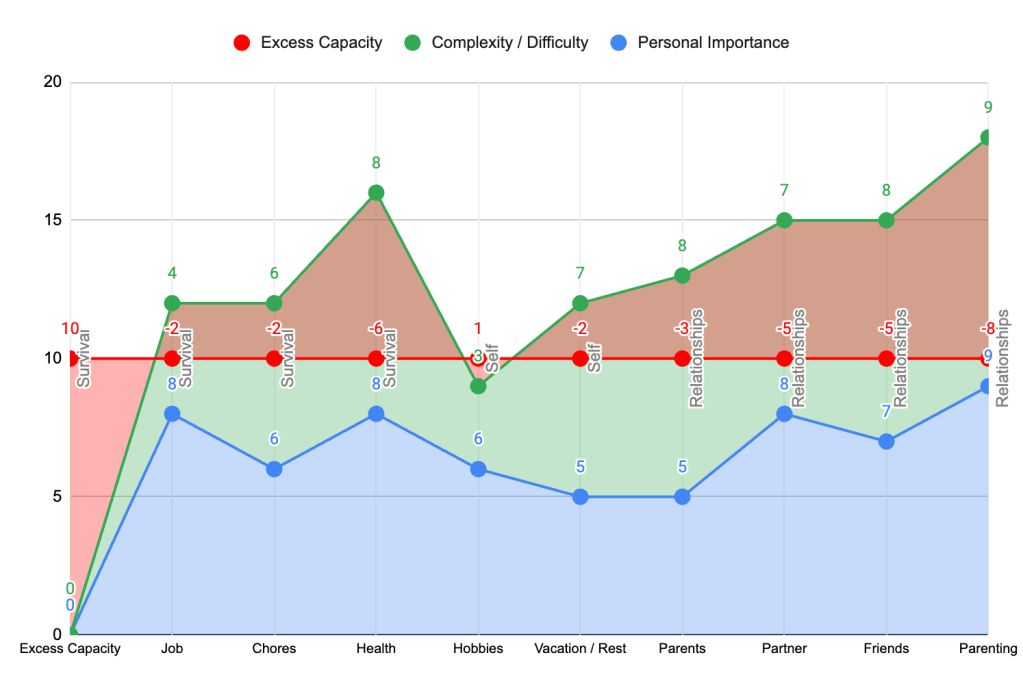
My Burnout Calculation (As an Example)
Here’s my current breakdown:
| Category | Responsibility | Importance | Complexity | Total Stress |
| Survival | Job | 8 | 4 | 12 |
| Survival | Chores | 6 | 6 | 12 |
| Survival | Health | 8 | 8 | 16 |
| Self | Hobbies | 6 | 3 | 9 |
| Self | Vacation/Rest | 5 | 7 | 12 |
| Relationships | Parents | 5 | 10 | 15 |
| Relationships | Partner | 8 | 6 | 14 |
| Relationships | Friends | 7 | 7 | 14 |
| Relationships | Parenting | 9 | 9 | 18 |
Alex’s Total Required Capacity: 122 points
My Maximum Capacity: 100
My Excess Capacity: -22
Why my capacity isn’t higher: I don’t adjust the 100 down for having ADHD or being divorced. Instead, I score my responsibilities higher because they’re genuinely harder for me. For example, my “Health” scores 8+8=16 because ADHD makes routine health habits extremely complex to maintain.
Conclusion: I am operating at a significant deficit. No wonder I feel burned the fuck out most days.
What This Means (And What to Do About It)
Here’s the uncomfortable truth: You can’t just “manage your stress better” if you’re operating at a deficit.
All those bullshit corporate wellness programs that tell you to “practice self-care” and “set boundaries”? They’re not wrong, but they’re incomplete. You can’t yoga your way out of having more responsibilities than you have capacity to handle.
You have three options:
Option 1: Increase Your Maximum Capacity
This is the long-term play. Work on: – Physical health: Sleep, exercise, nutrition (I know, I know, but it actually works) – Mental health: Therapy, medication if needed, developing coping skills – Support systems: Building a network of people who can help shoulder the load – Skills development: Get better at the things that create complexity
This takes time—months or years—but it’s the most sustainable path.
Option 2: Reduce Your Required Capacity
This is the hard one because it requires letting go: – Lower your standards: Maybe your house doesn’t need to be spotless. Maybe that report doesn’t need to be perfect. – Delegate: Pay for services, ask for help, stop being a hero – Say no: To new responsibilities, to social obligations, to that PTA committee – Eliminate: What can you completely remove from your plate?
This feels like failure. It’s not. It’s survival.
Option 3: Suffer
Don’t do this one. This is where most of us live by default, and it ends in divorce, job loss, health crisis, or worse.
The Critical Insight You’re Missing
Here’s something that took me years of therapy to understand: The amount of time a responsibility takes is NOT the primary driver of stress.
You might spend 8 hours a day at work, but if that work is straightforward and you don’t care that much about it, it might not be your biggest stressor. Meanwhile, you might spend only 30 minutes a week calling your aging parent, but if that relationship is complex and emotionally fraught, those 30 minutes could be eating up more of your overall mental capacity than your entire workday.
This is why people burn out on things that “shouldn’t” be that hard. You’re not weak. You’re not lazy. You’re just operating at a deficit, and your body is trying to tell you that.
A Final Note on Personality Importance vs. Actual Importance
One more critical insight: What matters to you personally is a personal choice… to a point.
I’m not going to recommend you score some aspect of your physical health a 1, or leave it off your priority list completely. I think there is a basic level of health, relationships, and personal identity (i.e., your work, your hobbies) that require a minimum level of prioritization for every human being in order to be happy AND be able to show up for whatever else makes your list. If you’re lazy and want some help in this area (or are so burned out at this point that you can’t do much more that sit around watching TV all day) watch the documentary “Stutz” on Netflix (if you can’t tell by now I really like Mr. Stutz) – it’s about a famous Psychiatrist named Phil Stutz who over his long career ended up treating a lot of Hollywood people including Jonah Hill who loved him so much he made a pretty chill movie about him.
Stutz has a concept called The Life Force Pyramid that if I may summarize states that no matter who you are, what you have going on in your life, and what happened to you to get you there, there are three things that every human can do to improve their overall state of well being, by focusing on your relationship with: 1) Your Body (sleep, movement, diet) 2) Your Relationships (Friends, Family, Community) 3) Your-self (Self-reflection…which is hard so Stutz says just write down ANYTHING going through your head, and if that is too scary for you don’t call it journaling call it “Brain Exercise” or something your bros won’t bust you for…).
But everyone is different. The point is that we all have a maximum amount of capacity, and how each of us utilizes (or over- or under-utilizes) this capacity depends on: 1. How much personal importance or priority individual responsibilities have to us (we all have minimum responsibilities) 2. How complex or (over time) “standardized” our responsibilities are 3. Ultimately, how capable we are at managing everything
Some people are naturally more resilient or were raised to be. Some people have issues like severe ADHD (🙋) that make the complexity of tasks/responsibilities much more difficult or intensive. Some people are naturally good at solving problems or being calm under pressure.
We all have strengths and weaknesses that can apply to individual responsibilities, or to how we manage them all holistically.
Now Go Do the Work
Stop reading and actually do the exercise. I’m serious. Grab a piece of paper right now and: 1. List your top 10 responsibilities 2. Score them on Importance and Complexity 3. Calculate your Total Stress for each 4. Add them up (Required Capacity) 5. Honestly assess your Maximum Capacity 6. Calculate your Excess Capacity
If you’re negative, stop lying to yourself about “powering through” and make a plan to either increase capacity or reduce requirements.
If you’re at zero, you’re one crisis away from a breakdown.
If you’re positive, congratulations—use that capacity wisely before life fills it up for you.
And if this helped you, share it with someone who needs to hear it. Because we’re all out here trying to figure this shit out, and maybe if we stop pretending we have it all together, we can actually help each other survive.
Want more brutally honest mental health content? Follow me for more posts where I turn therapy concepts into something you might actually use. Or don’t. I’m not your dad.
 AlexRochlitz.com
Leave a comment